The company name has been chosen, the trade register notification is done and the logo is with the designer. Yet one thing is often left until last: the domain. That is a mistake, because domains have no priority rights and no waiting list. A name belongs to whoever registers it first.
In this article, we compare the most common domain extensions, go through what kind of domain name to choose and explain how to register a domain for your business the right way.
In short: Register your domain name as soon as the company name is decided. If your customers are in Finland, choose .fi; if you operate or plan to operate abroad, also register .com. Always register the domain in your company’s name, not the website builder’s or the agency’s.
Domain extensions compared
| Extension | Best for | Who can register | Period |
|---|---|---|---|
| .fi | The Finnish market | Anyone | 1–5 yrs |
| .com | International business | Anyone | 1–10 yrs |
| .eu | Several EU countries | EU/EEA businesses and residents, EU citizens | 1–10 yrs |
| .net, .org | Extra protection, associations | Anyone | 1–10 yrs |
| New | Campaigns, extra addresses | Usually anyone | Varies |
Quick picks:
- Your customers are in Finland → .fi
- You sell or plan to sell abroad → .fi and .com
- You operate in several EU countries → .eu alongside your .fi address
- You want to protect your brand → .com and the most common typos in addition to your main address
- You are an association or non-profit → .fi, and .org if needed
You can see current prices on our domains page and at the end of this article.
What is a domain?
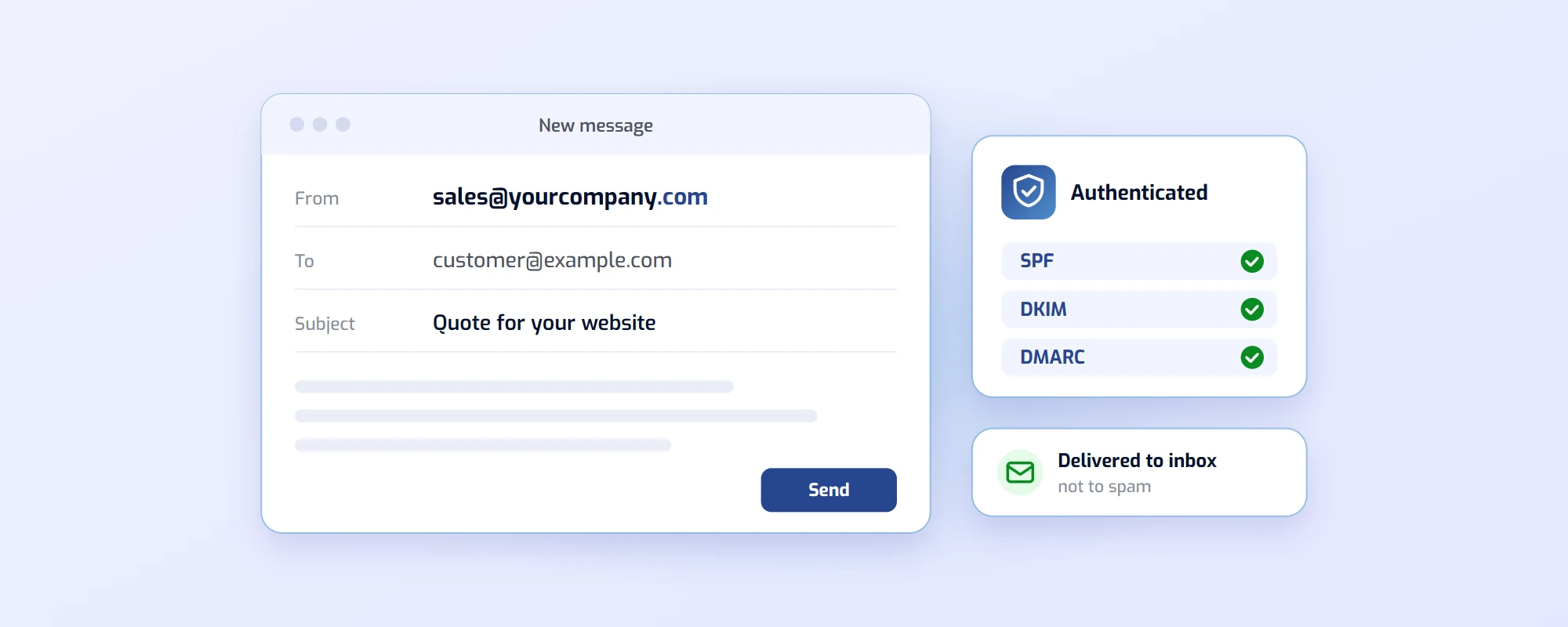
A domain is your business’s address on the internet, for example novasolu.fi. It has two parts: the name itself (novasolu) and the extension (.fi). The same domain is used both as your website address and for email, for example info@novasolu.fi.
So a domain is much more than a website address. It appears on business cards, invoices, ads and every email you send. Changing it later is laborious and expensive.
Register before you tell anyone the name
Domain squatting means that someone registers a domain matching another company’s or product’s name and later tries to sell it back at a high price or uses it for their own purposes. Squatters watch new company registrations, press releases and product launches, for example.
Registering a domain costs only a few tens of euros a year. Getting back a name that has already been taken can cost hundreds or thousands of euros – if it is possible at all. That is why we recommend this order:
- Decide on the name.
- Check that the domain is available.
- Register the domain immediately.
- Only then announce the name, order the logo and print the business cards.
What kind of domain name should you choose?
- Short and easy to remember. The shorter the name, the easier it is to type correctly and remember.
- Easy to say out loud. Test it: if you give the address over the phone, do you have to spell it out?
- Avoid hyphens and numbers. They are easily forgotten and unclear when spoken.
- Mind the Finnish letters. A .fi domain may contain the letters å, ä and ö, but not everyone remembers to type them, and foreign keyboards don’t always have them. If your name contains them, also register a version without (for example mäkelä.fi and makela.fi).
- The same name everywhere. If possible, claim the same name on social media services too.
A .fi domain can be 2–63 characters long. The allowed characters are the letters a–z, å, ä and ö, numbers and the hyphen, which must not be at the start or end of the name.
The extensions in detail
.fi
Best for: businesses whose customers are in Finland.
.fi immediately tells people you are a Finnish business and builds trust. Anyone can register one: an individual, a company or an organisation. .fi domains are administered by Traficom, and the rules are clear: the holder’s identity is verified, and a domain that infringes a trademark can be transferred to the rightful holder.
Keep in mind: For most Finnish businesses .fi is the best main address, even if the site also has an English version.
.com
Best for: businesses that operate internationally or plan to.
.com is the best-known extension in the world, and foreign customers often type it automatically. Many Finnish businesses register .com even if they only actively use their .fi address. The other one is redirected to the main site, so nobody else can use your name with a different extension.
Keep in mind: Short .com names are often already taken. Don’t settle for an awkward variation just because the extension is .com – a good .fi name beats a bad .com name.
.eu
Best for: businesses that sell to several EU countries.
.eu says European without tying you to one country. It can be registered by a company established in the EU or EEA, a person living there, or an EU citizen wherever they live.
Keep in mind: .eu is less common in Finland than .fi and .com, so it works best as an extra address or as the main address of a clearly European brand.
.net and .org
Best for: extra protection, and associations (.org).
.net and .org are old, trusted extensions that anyone can register. .org is still seen as the extension for non-profits and associations.
Keep in mind: They rarely suit a business’s main address, because customers easily type .fi or .com and end up on someone else’s site.
New extensions
Best for: campaign sites and extra addresses.
There are hundreds of new extensions, such as .shop and .online, and they often have a free name that is already taken with .fi and .com. They can work well as the address of a campaign or a product.
Keep in mind: We don’t recommend them as the main address for most businesses. They are less familiar, and the renewal price can be much higher than the first year’s price, so check both before you register.
Why register through an official registrar?
.fi domains are administered by the Finnish Transport and Communications Agency Traficom, but registrations are always made through a domain registrar. NovaSolu is an official Traficom .fi domain registrar, so registration goes directly through us without intermediaries.
When it is handled through an official registrar:
- The domain is in your name. Your company is recorded as the domain holder, not the advertising agency or the website builder. This matters if you ever change service provider.
- Your identity is verified. Under Traficom’s regulations, the registrant’s identity must always be verified. This protects both you and the whole .fi domain system from misuse.
- Registration is fast. When you register a domain through our client portal, it is processed immediately.
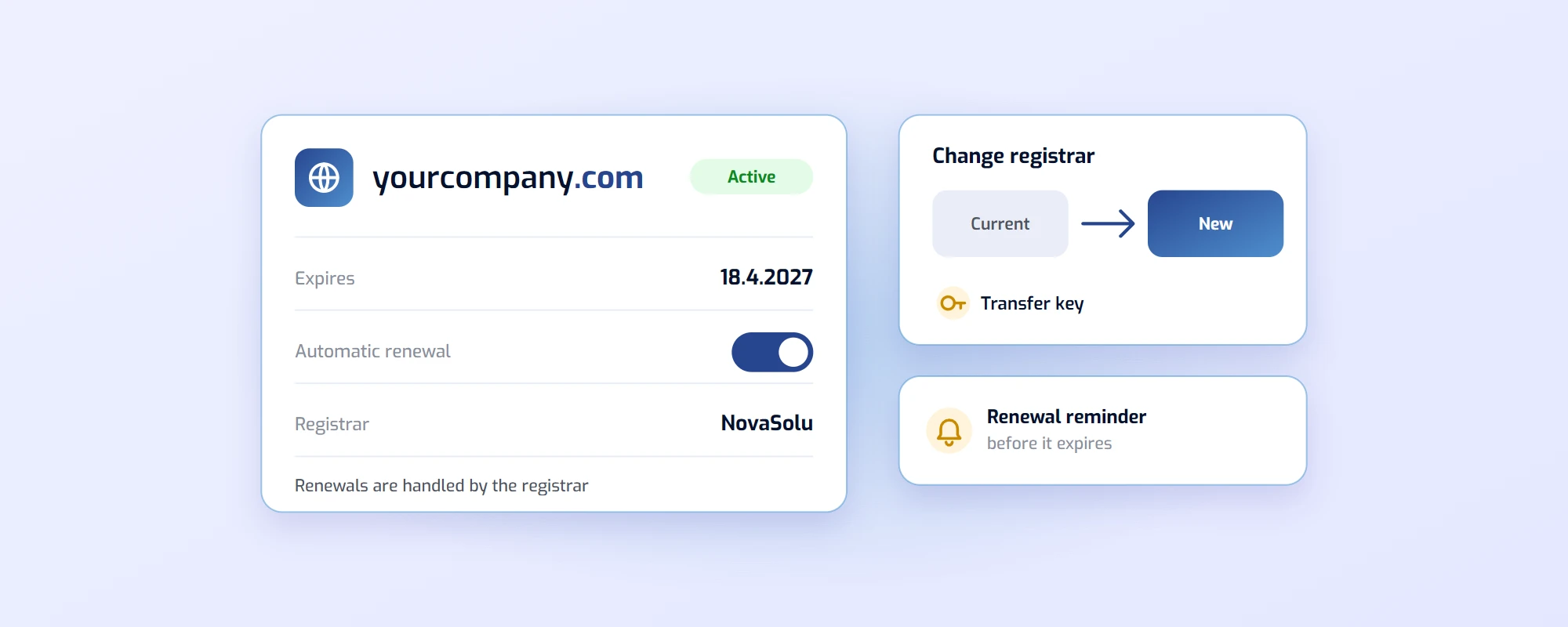
- A transfer is always possible. You get a transfer key from us, which you can use to move the domain to another registrar if you wish.
- You won’t forget to renew. You get a reminder before the domain expires, so the name doesn’t become available for others to register.
Mind trademarks and other people’s names
Registering a domain does not give you the right to use another company’s name or trademark. If you register a domain that infringes someone else’s protected name or trademark, Traficom may in certain cases remove the domain or transfer it to the rights holder. So before registering, check that the name is not already in use by someone else, for example in the trade register and the trademark register.
It also works the other way round: once your company name is registered in the trade register or as a trademark, it strengthens your position if someone tries to squat your name as a domain.
How to register a domain for your business
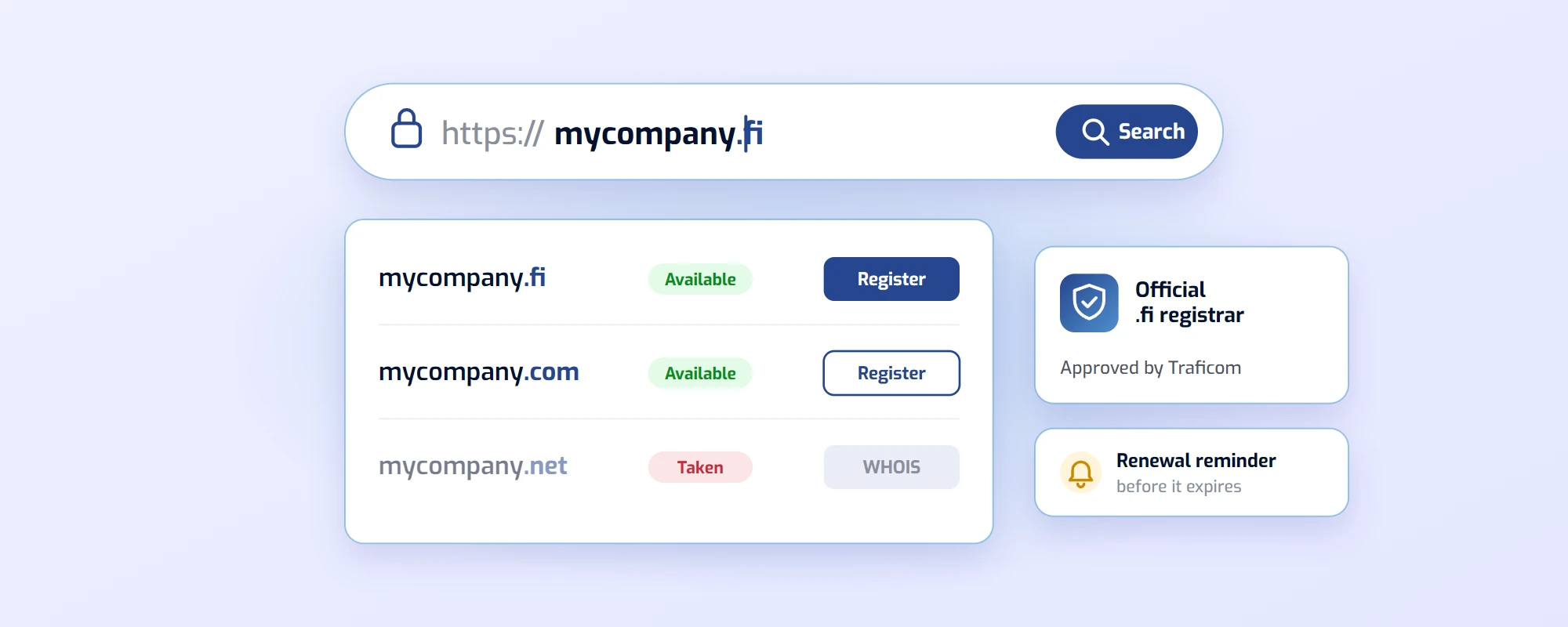
- Check availability with our domain search. If the name is taken, the WHOIS lookup tool tells you who holds it and when it expires.
- Register .fi and, if needed, .com as well as the most important variations.
- Register it in the company’s name, not personally or in your service provider’s name.
- Choose a long enough registration period. A .fi domain can be registered for 1–5 years at a time.
- Keep your contact details up to date, so the renewal reminders reach you.
- Put the domain to use. Connect email on your own domain and your website to it.
Domain registration FAQ
How much does registering a domain name cost?
The most common extensions cost from a few euros to a few tens of euros a year. The price depends on the extension and the registrar, and many registrars charge more for renewal than for the first year, so compare the renewal price too. You can see our prices on the domains page.
How quickly can I use the domain?
The registration is valid immediately. When the domain is connected to a website or email, name server changes usually spread within a few hours.
Can I register a .com domain from Finland?
Yes. .com, .net and .org have no country restrictions, so a Finnish company or person can register them just like a .fi domain.
Who owns a domain that the website builder registered?
Whoever is recorded as the domain holder. If the builder registered the domain in their own name, they technically control it. Check your own domain with the WHOIS lookup and ask for a change of holder if needed.
What happens if I forget to renew my domain?
Your website and email stop working, and after the grace period anyone can register the name. Read more in renewing and transferring a domain.
Summary
A domain is one of your business’s most important digital identifiers, and also one of the cheapest. Register the name as soon as you have decided on it, choose a short name that is easy to remember and make sure the domain is in your own company’s name. For a business operating in Finland, .fi is usually the best main address, with .com registered alongside it.
Check whether the name you want is available now – registration takes only a few minutes. If you need a website as well as a domain, see our website pricing.